Wow, can you believe the last supermoon of 2022 is almost here!? By now, I’m sure many of you have seen the sensational headlines about it, just like we see nowadays for every “supermoon”. Think back about 10 years ago though - did you ever even hear the word then? It turns out supermoons are really no different than every other full moon, and all of those headlines are essentially clickbait.

May, 2020 Supermoon. It may look big, but that’s simply due to my position. Single Exposure, 500mm 🔹 F/8 🔹1/125 sec. 🔹 ISO 125
So what is a supermoon anyway? I’m so glad you asked! Wait, I guess that was me that asked. Anyhow, the funny thing is, it’s not even an actual scientific or astronomical term. There’s no official or consistent way to designate which moons are super. Search the internet and you’ll find varying explanations, even from sources most people would trust, such as Nasa.gov, TimeAndDate.com, and EarthySky.org. Many sources define it as something along the lines of when the full moon coincides with its closest approach to earth in its elliptical orbit, called perigee. But by that delineation, they would be quite rare and we wouldn’t expect to hear about them occurring so often. Most media is actually using a much broader definition, which is when a full moon is within 90% of its perigee. Using this rationale, there are 3-5 supermoons every year. That means some years you can have these “Must see” event headlines for 5 months straight! The next time that occurs isn’t until 2029, but then happens for 5 years in a row. As it turns out, this looser definition is actually as official as there is, since it comes from the man who is attributed with coining the term in 1979, astrologer Richard Nolle. His use is a little more complex than I’ll dive into today though, and the 90% is arbitrary as far as we know.
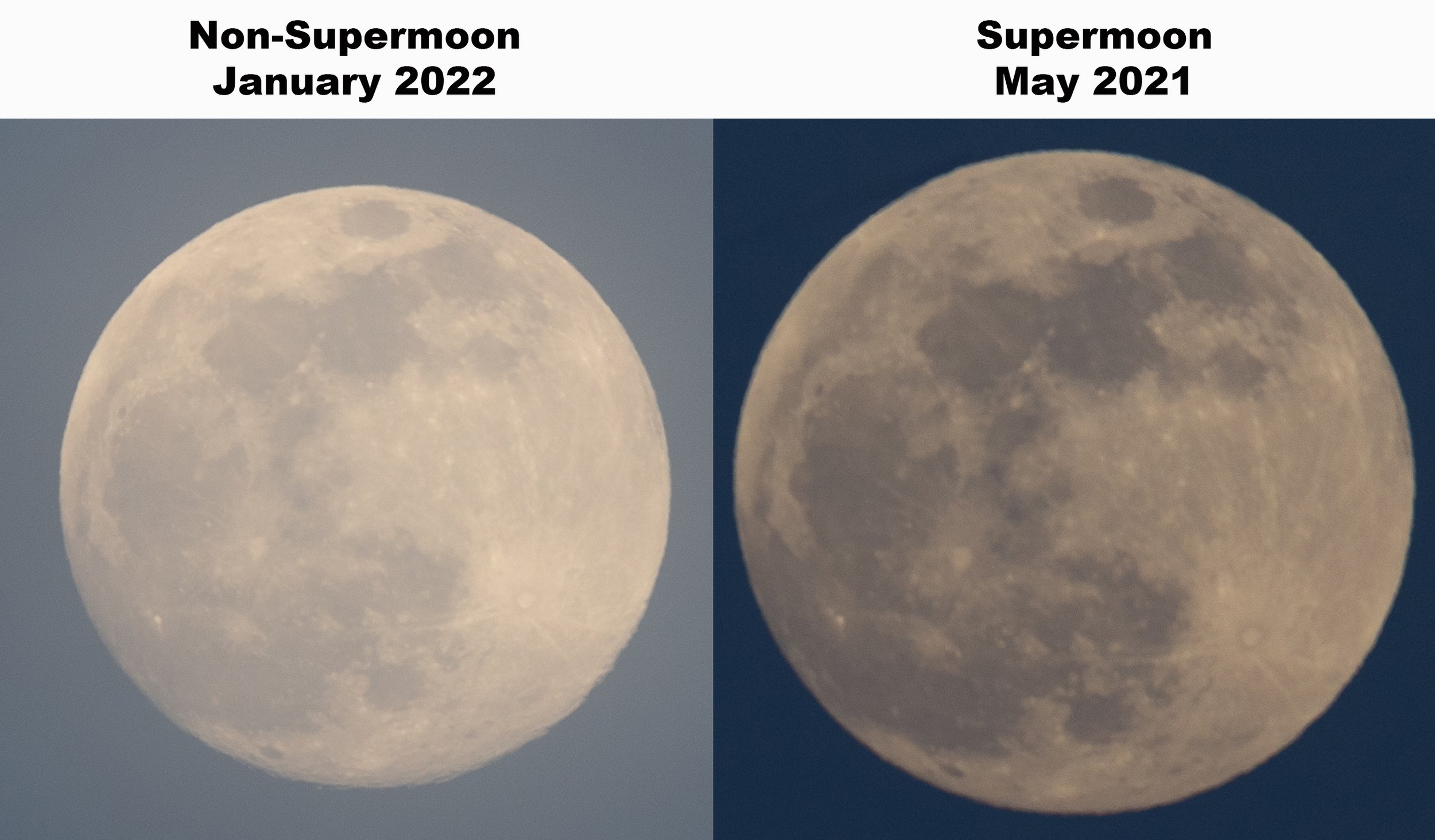
The difference in size may seem obvious when compared side by side, but to any observer on the ground it’s not apparent. Remember, if you hold your hand out at arm’s length, your pinky nail will completely cover the moon, regardless of the month. For both of these photos I used the same camera, lens, zoom, and crop for an accurate comparison.
Regardless of which definition you or anybody uses, the bottom line is this: To observers, a supermoon is not distinguishable from any other full moon. Since the moon’s orbit around earth is not circular, but elliptical, its distance always varies, between around 221,500 miles and 252,700 miles away from earth. All full moons are different sizes, because it’s never the exact same distance away, but those differences aren’t big enough for us to perceive, unless we’re doing a side by side comparison. If you don’t believe me, try this experiment: For a complete year, watch every full moon rise. At the end of the year, tell me which 3 moons you thought appeared to be the biggest. Oh yeah, and you’re going to have to avoid any news, information, or announcement from friends when the supermoons will be. I’ll bet money you won’t be able to choose the right ones. Of course, I know nobody’s going to actually do this, but hopefully you get the idea. Yes, in reality the supermoons are a bit brighter and bigger, but again, it’s not noticeable to the casual observer. And for photographers, the supermoon factor is irrelevant, since things like focal length and crop change the moon’s size anyways. You can get “big moon” photos any month of any year, using a simple perspective trick. And just in case anybody was wondering, there’s nothing about a supermoon that will make it appear a different color than normal.

Full moon of September 2019. NOT a supermoon. Any full moon can be made to appear big by using a telephoto lens and positioning yourself far away from the subject on the ground. Single exposure, 550mm 🔹 F/9 🔹1/250 sec. 🔹 ISO 200.
Now, don’t get me wrong, it seems like a lot of people are encouraged to get out to view the moon because they saw headlines saying, “Don’t miss the supermoon!”, and I think that’s great. But, it is a bit misleading, and to me can be categorized as a clickbait headline because it is exaggerated hype. I’ve also seen articles for things like “How to photograph the supermoon”. Well, rest assured that the method for photographing the supermoon is no different than every other, and “How to see the last Supermoon of the year” will also be the same as how you see any full moon of the year. So, if you have prior engagements and can’t see the last Supermoon of 2022 next week, don’t worry. And if you want to watch the moonrise next month for an “average” moon, go for it! Simply get out there for some moon gazing or photographing whenever you feel like it, which should be every month you can!

A lunar eclipse and supermoon from May 2022. You can read the story behind this shot here. Single exposure, 260mm 🔹 F/6.3 🔹0.3 sec. 🔹 ISO 125
